Politics
Deepening Uganda-Tanzania Relations Focus on Energy and Regional Peace
The East African Crude Oil Pipeline (EACOP) remains on track, with oil transportation expected to begin in July 2026.

In a significant step toward enhanced bilateral relations, Ugandan President Yoweri Kaguta Museveni visited Tanzania to hold high-level talks with President Samia Suluhu Hassan. The discussions, held in Dar es Salaam, centered on strengthening cooperation in energy development, trade facilitation, infrastructure, and regional peace. While the agenda covered a broad spectrum of mutual interests, the spotlight was firmly on the energy sector, particularly the East African Crude Oil Pipeline (EACOP) and related initiatives that promise to transform the economic landscapes of both nations.
During a joint press briefing following the bilateral meetings, President Samia announced that the two leaders had reviewed the progress of key energy infrastructure projects. She emphasized that the EACOP project remains on track, with oil transportation slated to commence in July 2026. This 1,443-kilometer pipeline, stretching from Uganda’s Albertine Graben to the Tanzanian port of Tanga, represents a cornerstone of East Africa’s energy ambitions, enabling Uganda to export its crude oil reserves for the first time.
The EACOP, a joint venture involving TotalEnergies, China National Offshore Oil Corporation (CNOOC), and the governments of Uganda and Tanzania, is not just a conduit for oil but a catalyst for regional economic integration. President Samia highlighted additional cooperative ventures, including plans for a gas pipeline from Tanzania to Uganda and a refined oil pipeline from Uganda to Tanga. These projects position Tanzania as a vital export corridor for Uganda’s petroleum products, fostering shared prosperity through joint energy production aimed at meeting domestic demands while tapping into regional and international markets.
Building on this momentum, recent developments underscore the project’s commitment to local empowerment and innovation. Just weeks before the presidential summit, on January 30, 2026, EACOP hosted its first Supplier Development Forum of the year at the Sheraton Hotel in Kampala. The event drew over 200 in-person attendees and more than 800 online participants, showcasing robust interest from Ugandan businesses in the project’s commissioning and operations phases.
EACOP Deputy Managing Director John Bosco Habumugisha stressed that local content is integral to the project’s vision, urging Ugandan companies to seize opportunities in specialized equipment, technical services, and procurement. Presentations from industry experts, including Kamal Bouzalmata (Commissioning Manager) and Christophe Carmon (Deputy Field Operations Director), outlined avenues for sustainable engagement, emphasizing collaboration with Tier One contractors and adherence to high standards.
Jimmy Mugerwa from the Industry Enhancement Centre highlighted how such initiatives extend benefits to local communities through capacity building, job creation, and technology transfer. The forum reinforced EACOP’s role in bolstering national content, with the pipeline’s construction combined with Uganda’s Tilenga and Kingfisher upstream projects expected to generate substantial tax revenues for both host governments, create thousands of jobs, and enhance the trade corridor between Uganda and Tanzania.
Innovation is at the heart of EACOP’s design, setting it apart as a forward-thinking infrastructure project. One standout feature is the integration of fibre optic cables with an advanced detection and analytical system for continuous monitoring. This technology enables early detection of soil movements or landslides, identifies potential intrusions along the pipeline’s right-of-way, detects temperature variations signaling leaks or exposures, and allows for sectional isolation via in-line block valves to minimize environmental risks.
Equally impressive is EACOP’s hybrid power generation system, which combines grid connections from Tanzania and Uganda with battery banks, a solar farm at the Tanga terminal, and backup combustion engines. This setup achieves at least a 30% reduction in carbon footprint compared to traditional systems. The 4MWp solar farm, spanning an area equivalent to two football pitches and comprising 6,200 panels, along with battery energy storage systems (BESS) to handle grid instabilities, exemplifies the project’s environmental stewardship. An advanced Electrical Management System (EMS) ensures seamless integration of these diverse power sources, supporting reliable operations across pumping stations and terminal facilities.
Beyond energy, the leaders addressed trade and logistics enhancements. President Samia noted efforts to improve Ugandan traders’ access to Tanzanian ports like Tanga and Dar es Salaam, including requests for extended railway connectivity into Uganda to streamline cargo movement. Both sides committed to eliminating persistent non-tariff barriers, recognizing that such measures will accelerate economic growth and fortify the East African regional market.

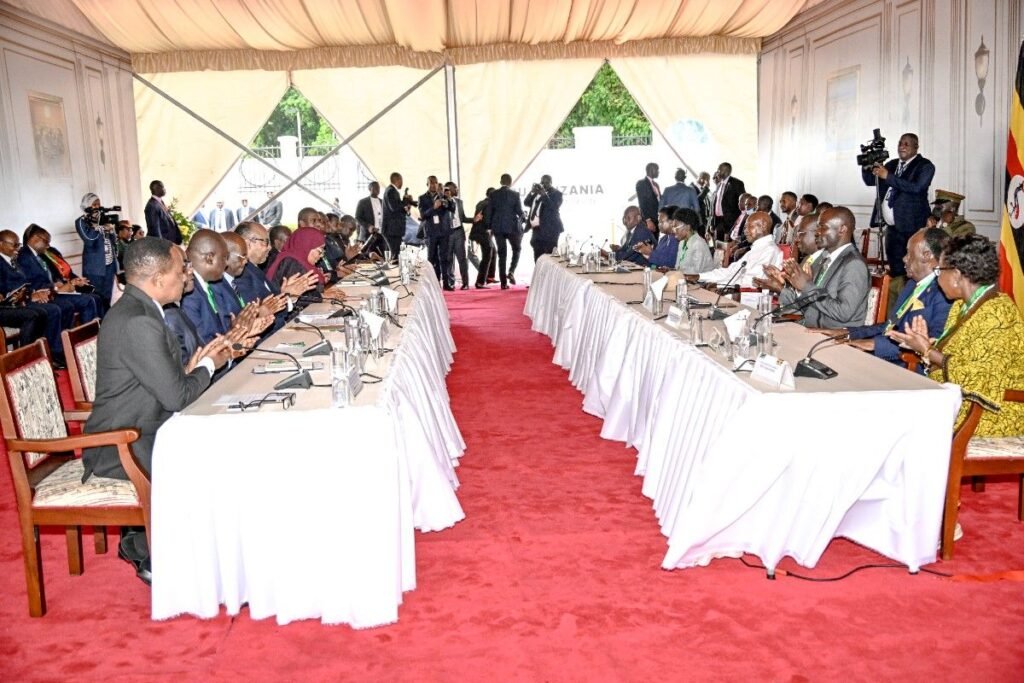
On regional peace and security, the discussions focused on strategies for stability in the Great Lakes Region, with plans for dialogue processes to resolve ongoing conflicts. President Museveni echoed this sentiment, stressing the need to protect Africa’s hard-won independence through economic resilience and unity. He highlighted strategic security as a priority, noting that Uganda and Tanzania had tackled several tactical issues during the talks. Additionally, the leaders explored industrial specialization, with Tanzania leading in locomotive manufacturing and Uganda in textiles, to leverage complementary strengths.
In his remarks, President Museveni framed these collaborations as a continuation of Africa’s liberation struggle, emphasizing that true prosperity stems from producing and selling goods competitively to generate citizen income. He warned against external pressures from powerful nations, underscoring that Africa’s response hinges on internal strength and cohesion.
President Samia warmly welcomed Museveni, calling Tanzania his “home” and congratulating him on the National Resistance Movement’s recent electoral victory, crediting it to the party’s clear ideology and manifesto. She reaffirmed Tanzania’s dedication to close partnership with Uganda.
As the two nations move forward, the Museveni-Samia summit signals a renewed era of collaboration, with the energy sector, particularly the innovative and economically transformative EACOP, poised to drive sustainable development across East Africa. This partnership not only bolsters bilateral ties but also contributes to the broader goal of regional integration and self-reliance.