
Blog
TuneCore Launches Groundbreaking ‘Advanced Trends and Analytics’ Dashboard for Self-Releasing Artists

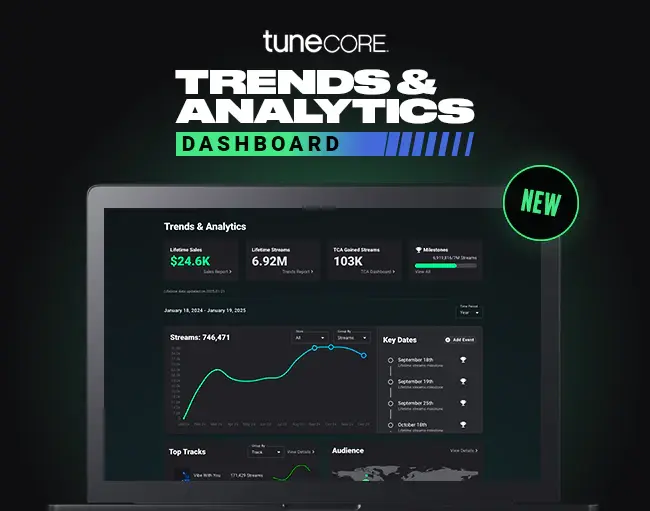
In the ever-evolving world of music, independent artists require powerful tools to navigate their careers and grow their audiences. TuneCore, the distribution platform owned by Believe, has made significant strides in this area by launching its Advanced Trends and Analytics Dashboard. This innovative tool is designed to provide artists with in-depth insights and performance metrics, allowing them to make smarter, data-driven decisions that foster their growth.
Unlocking the Power of Data for Independent Artists
The new dashboard, now available to all TuneCore users, offers a comprehensive suite of features aimed at empowering self-releasing artists. Its five core functions provide artists with a clear view of their music’s performance across various platforms, enabling them to track trends, optimize strategies, and unlock new growth opportunities.
- Cross-Platform Performance Tracking
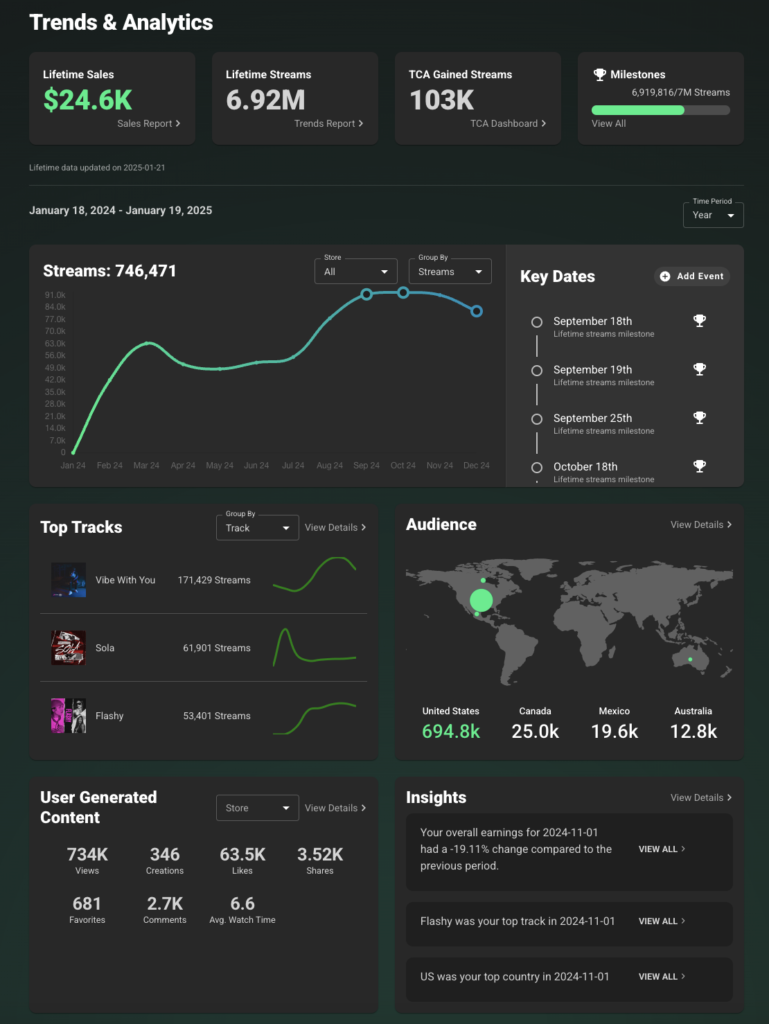
Artists can now monitor their streaming and download statistics across major digital service providers (DSPs) such as Spotify, Apple Music, and Amazon Music. Additionally, exclusive social media analytics from TikTok and Douyin are integrated, offering valuable insights into audience engagement and content performance on these rapidly growing platforms. This cross-platform data equips artists with the tools they need to understand where their fans are and how to capitalize on these insights to advance their careers.
- Real-Time Engagement Metrics
With daily updates on key metrics such as views, shares, likes, comments, and average watch time, artists can instantly assess the performance of their content. These real-time analytics enable artists to track ongoing fan engagement and refine their promotional strategies based on what resonates with their audience.
- Comprehensive Audience Insights
The dashboard features detailed visualized data on listener engagement by location, allowing artists to identify where their audience is based. This insight enables them to target specific regions effectively and plan marketing strategies that resonate with these fanbases. Understanding geographic trends can help artists optimize their tours, promotions, and releases.
- Actionable Growth Metrics
An interactive timeline offers a quick view of an artist’s performance trends over time. It highlights key actions that have contributed to growth, such as the release of a new song or a viral TikTok post. This feature enables artists to pinpoint what works and adjust their strategies to replicate successful outcomes in the future.
- Exclusive TuneCore Accelerator Insights
Artists participating in the TuneCore Accelerator program gain access to additional insights, allowing them to track the increase in streaming driven by TuneCore’s marketing efforts. This feature reveals how promotional placements impact their growth, providing a clearer picture of how TuneCore’s marketing programs contribute to their success.
Customization for Deeper Insights
One of the standout features of the new dashboard is its customization options. Artists can filter their streaming data by store and type (streams or downloads) and adjust the time period filter (weekly, monthly, or yearly) to track specific performance metrics over time. This flexibility allows artists to focus on the metrics that matter most to their unique strategies.
Key Dates for Tracking Milestones
The dashboard also includes a Key Dates section where artists can record important events, such as release shows, album drops, or viral TikTok moments. By correlating these milestones with performance data, artists can more easily identify which actions drive success.
In-Depth Analysis of Top Tracks and User-Generated Content
The Top Tracks section provides artists with a detailed view of their most successful releases, while the User-Generated Content section offers analytics from platforms like TikTok and Douyin. These insights reveal which pieces of content drive the most engagement, allowing artists to fine-tune their content strategies and maximize their reach. With TikTok and Douyin generating over 1.5 billion video views daily, these insights are critical for understanding trends and effectively monetizing fan engagement.
Revenue Tracking: Monetizing Engagement
In addition to monetizing fan engagement via TikTok and Douyin, the dashboard allows artists to track their earnings alongside engagement metrics. By connecting audience insights to revenue generation, artists can evaluate how their content and fan engagement impact their bottom line. This holistic view of performance and earnings ensures artists can make informed decisions about the best ways to monetize their efforts.
Comparison with Competitors
TuneCore stands out from other music distribution platforms due to its unique all-in-one Advanced Trends and Analytics Dashboard. Unlike its competitors, TuneCore provides unparalleled insights, including exclusive social media analytics from platforms like TikTok and Douyin. This emphasis on offering independent artists access to crucial, real-time data from various sources ensures they have a comprehensive understanding of their music’s performance and audience behavior. Currently, no other platform offers this level of integration across major digital service providers (DSPs) and social media networks.
User Testimonials and Case Studies
Early access to the dashboard has already created excitement among artists. Caleb Gordon, a rising hip-hop star, expressed his enthusiasm: “Yooo, this is fire! I’m always checking my analytics to stay strategic with my releases and promotions, and this new TuneCore dashboard makes it way easier to track everything in one place. I can really understand my audience better now and focus on what’s working.” Providing insights on how various types of artists—from indie pop stars to emerging hip-hop talents—are utilizing the dashboard for their specific needs would offer even more valuable context for readers.
A New Era for Independent Artists
The Advanced Trends & Analytics Dashboard is more than just a performance tracking tool; it’s a game changer for independent artists aiming to succeed in the fast-paced music industry. With the capability to monitor streams, engagement, and audience demographics in real-time, artists can now make informed decisions that contribute to their growth directly.
Beyond Streaming: Monetizing Fan Engagement
One of the dashboard’s key advantages is its ability to track audience behavior on platforms like TikTok and Douyin, which collectively generate 1.5 billion video views daily. By monitoring user-generated content and analyzing its impact on streaming and downloads, artists can take advantage of social media trends to boost their revenue.
With TuneCore, artists can filter and search their data by time period (weekly, monthly, or yearly) and track significant milestones, such as the release of a new track or a viral moment. The “Top Tracks” and “User-Generated Content” sections provide an in-depth look at which releases and posts resonate most with fans, enabling artists to plan future content with confidence.
A Comprehensive Approach to Success
The Advanced Trends & Analytics Dashboard is the latest addition to TuneCore’s growing suite of tools designed to help independent artists thrive. Following the 2023 launch of the TuneCore Accelerator program, artists have seen remarkable results, with tracks in the program reaching 21 billion streams in 2024 alone.
By providing tools that extend beyond simple distribution, TuneCore empowers artists to take control of their careers and build a sustainable, long-term path to success. Whether you are an up-and-coming artist or an established name, the Trends & Analytics Dashboard is a transformative tool that will help you understand your audience, optimize your promotional strategies, and elevate your music career.
For independent artists looking to make smarter, data-driven decisions, the Advanced Trends & Analytics Dashboard from TuneCore is the key to unlocking new growth and success in the competitive music industry

Politics
Uganda Launches Evacuation of Nationals from South Africa Amid Rising Xenophobic Violence
Following rising xenophobic attacks, Uganda has launched an urgent evacuation of its nationals from South Africa. 746 citizens have already registered as President Museveni orders special flights home.


President Yoweri Kaguta Museveni has directed the Ministry of Foreign Affairs, in coordination with several other government bodies, to finalize and implement the evacuation operation, which is expected to begin in the coming days.
According to a press statement issued by the Ministry today, 746 Ugandans have already voluntarily registered for assisted evacuation due to serious safety and security concerns. Many more are expected to register, while numerous others have already left South Africa independently after vigilante groups reportedly issued a deadline of 30 June 2026.
The evacuation plan includes registering affected nationals across South African provinces, transferring them to safe assembly points, issuing emergency travel documents where needed, and coordinating with immigration authorities. In partnership with the Ministry of Works and Transport, the government has arranged for Uganda Airlines to operate special charter flights, which will be fully funded by the Ugandan government.
The statement also noted that other African countries have similarly evacuated their nationals from South Africa in response to the current situation. Uganda continues to engage directly with the South African government to ensure the safety of the remaining Ugandan nationals.
In a somber development, the government confirmed that one Ugandan national was killed in an attack in KwaZulu-Natal Province. Preparations are underway to repatriate the body to Uganda, and the Acting Minister of Foreign Affairs has extended heartfelt condolences to the bereaved family.
Hon. Haruna Kyeyune Kasolo, Acting Minister of Foreign Affairs, signed the official statement, which emphasized the government’s commitment to the safety of its citizens abroad.
This marks a significant repatriation effort amid ongoing tensions in South Africa, where foreign nationals have faced repeated waves of xenophobic attacks in recent years.

Otto von Bismarck, known as the Iron Chancellor, was one of the most effective political marketers in modern history. Long before the invention of public relations firms, spin doctors, or social media, he demonstrated a masterful command of narrative control, strategic communication, and personal branding. Through calculated leaks, emotional appeals to nationalism, and a carefully crafted public image, Bismarck unified Germany in 1871. However, the very marketing strategies that propelled him to greatness also played a subtle but significant role in his dramatic fall from power in 1890.
Bismarck operated in an era of emerging mass media and rising nationalism. He understood that wars and treaties alone would not suffice; he needed to shape public perception. His most famous act of media manipulation occurred in 1870 with the Ems Dispatch. After a relatively polite diplomatic exchange between King Wilhelm I of Prussia and the French ambassador, Bismarck edited the telegram to make it sound deliberately insulting to both sides. He then leaked this provocative version to the press, knowing it would act like a “red rag” to the French bull. The result was exactly as he intended: France declared war, Prussia won decisively, and the victory paved the way for the proclamation of the German Empire at Versailles.
Beyond this masterstroke, Bismarck built a powerful personal brand. He presented himself as the gruff, no-nonsense Junker aristocrat in military uniform with a cigar in hand, iron will intact. Portraits, statues, and favorable newspaper coverage reinforced the image of a larger-than-life unifier who stood above petty politics. This “Iron Chancellor” persona helped him maintain support among German nationalists, even when his policies such as the Kulturkampf against Catholics or the anti-socialist laws generated opposition.
He also proved adept at narrative framing. When facing domestic rivals, Bismarck positioned the Prussian-led state as the defender of German unity and stability. He combined repression with innovation, introducing early welfare programs to undercut socialist appeal while portraying himself as a pragmatic protector of the working class. In foreign policy, he carefully painted the new Germany as a “satiated power” that sought peace after unification, all while maintaining a complex web of alliances designed to isolate potential enemies.
For nearly three decades, this combination of realpolitik and sophisticated storytelling kept Bismarck firmly in control. He transformed fragmented German states into a major European power and built a lasting myth around his leadership. However, the same branding genius that contributed to his success ultimately led to his downfall. By making himself the indispensable hero of the Reich, Bismarck created a highly personalized system of governance with few institutional checks. His cult of personality left little room for a smooth transition of power.
When the young and ambitious Kaiser Wilhelm II ascended the throne in 1888, he quickly grew tired of living in the shadow of this towering figure. Wilhelm wanted to rule in his own right and pursue a more assertive “New Course” in foreign and domestic policy. Bismarck’s larger-than-life image, once an asset, became a liability, positioning him as a rival rather than a loyal servant. After months of growing tension over policy direction and ministerial authority, Wilhelm forced Bismarck’s resignation in March 1890. The man who had engineered Germany’s birth was unceremoniously pushed aside by the very monarch he had helped elevate.
In the years that followed, Bismarck leaned even harder into his public persona through memoirs and press interviews, reinforcing the narrative of the wise elder statesman betrayed by youthful impulsiveness. This final act of personal branding helped shape historical memory many later blamed Wilhelm II’s decisions for Germany’s 20th-century tragedies but it offered little consolation to the chancellor who had lost real power.
Bismarck’s story offers a timeless lesson in leadership and communication. Exceptional marketing and branding can achieve extraordinary results, forging nations and reshaping history. Yet when that branding becomes too closely tied to one individual and when institutions remain weak, it can lead to isolation and removal. The tools that build empires can also limit their builders’ longevity.
In today’s world of personal brands, thought leadership, and digital narratives, Bismarck remains a fascinating case study: proof that the art of influence is powerful, double-edged, and as relevant now as it was in the 19th century.
Business
Bank of Uganda Sets A Bold Push Toward Digital Payments With New Cash Withdrawal Limits.
The Bank of Uganda has introduced new over-the-counter cash withdrawal limits effective 1 January 2027, capping individuals at UGX 50 million daily and corporates at UGX 250 million. The policy aims to accelerate digital payments while sparking debate on its impact on cash-reliant sectors.

The Bank of Uganda (BOU) has announced significant changes to cash withdrawal limits that will take effect on January 1, 2027. Under the new policy, individual customers will be limited to withdrawing a maximum of UGX 50 million per day and UGX 500 million per week from their accounts at commercial banks. Corporate accounts will have higher limits, allowing withdrawals of up to UGX 250 million daily and UGX 2.5 billion weekly. These limits apply only to over-the-counter cash transactions and do not affect electronic transfers, such as RTGS, EFTs, mobile money, or other digital payment channels.
This move represents one of the most direct interventions by Uganda’s central bank to accelerate the shift from cash to digital financial services. For years, BOU has encouraged electronic payments through various initiatives, highlighting their benefits, including faster transaction speeds, greater transparency, reduced costs related to printing and handling physical currency, and improved security. The new limits build on the observed growth in digital adoption, as many Ugandans and businesses already prefer mobile money, internet banking, and card payments for both everyday and larger transactions.
The policy also allows for flexibility in exceptional cases. Financial institutions under supervision can request exemptions for clients in cash-intensive sectors such as agriculture, fuel distribution, or large-scale trading after conducting proper risk assessments and obtaining BOU approval. This provision acknowledges that not every economic activity can transition overnight to fully digital methods, particularly in rural areas or sectors dominated by cash due to infrastructure limitations or client preferences.
Uganda’s economy has experienced rapid digital transformation. Mobile money transactions have surged in both volume and value, while platforms like the Uganda National Interbank Settlement System continue to mature. BOU officials argue that an excessive reliance on cash imposes hidden costs on the financial system, including risks of theft, money laundering, and inefficiencies in supply chains. By capping large cash withdrawals, the central bank aims to encourage both individuals and businesses to adopt safer, traceable digital alternatives that also generate valuable data for credit scoring and economic planning.
For the average salary earner or small business owner, daily life may not change dramatically, as most transactions fall well below the new thresholds. However, the real impact will likely be felt by high-net-worth individuals, large corporations, and operators in sectors that frequently handle substantial cash volumes. These groups will need to plan ahead, diversify their payment methods, and perhaps strengthen their relationships with banks to secure necessary exemptions.
Banks themselves will also need to adapt. Customer service teams will require training on the new rules, while relationship managers will play a greater role in advising clients on digital alternatives. Over time, this shift could drive innovation in financial products tailored to a less cash-dependent economy.
The success of this policy will depend on effective execution and complementary measures. If digital infrastructure reliably expands into rural districts, transaction fees decrease, and public trust in electronic systems continues to grow, Uganda could emerge as a regional leader in cashless financial services. Ongoing challenges regarding cybersecurity, digital literacy, and last-mile connectivity will need attention.
As the January 1, 2027 deadline approaches, businesses and individuals would be wise to review their cash handling practices and explore digital tools that align with this new reality. The Bank of Uganda’s message is clear: the future of money in Uganda is increasingly digital, and the transition is not just encouraged but actively facilitated from the top.


Uganda Launches Evacuation of Nationals from South Africa Amid Rising Xenophobic Violence

Otto von Bismarck, The Marketing Genius Who Built an Empire and Hastened His Own Downfall

Bank of Uganda Sets A Bold Push Toward Digital Payments With New Cash Withdrawal Limits.


-

 Entertainment2 years ago
Museveni’s 2025 Copyright for Musicians breakdown
-

 Sports1 year ago
The Transformative Impact of World Cup Qualification for Uganda
-

 Business2 years ago
The 9 worst mistakes you can ever make at work
-

 Policies2 years ago
Breakdown of the Uganda Police Force Annual Crime Report 2024
-

 Business2 years ago
Uganda’s Ministry of Finance projects significant growth opportunities in 2025
-

 Entertainment2 years ago
Uganda Cracksdown On Vulgar Music Content | Gloria Bugie, Shakira Shakira, targeted
-

 Policies2 years ago
Is Uganda’s Shs10m Fine the WORST Thing for Cohabiting Couples?
-

 Health2 years ago
Breaking down the Malaria Vaccine Rollout in Uganda
Rey Macc
February 22, 2025 at 7:13 am
Great Article